Detecting cognitive decline early with AI and digital biomarkers
MARC JONES: There is published data that suggests as many as 180 to 200 million people walking around with undiagnosed mild cognitive impairment, which is the biggest misnomer. It shouldn't be called "mild," because it's anything but mild. This is the earliest diagnosable stage of cognitive decline that's moving you off of normal brain aging.
[MUSIC PLAYING]
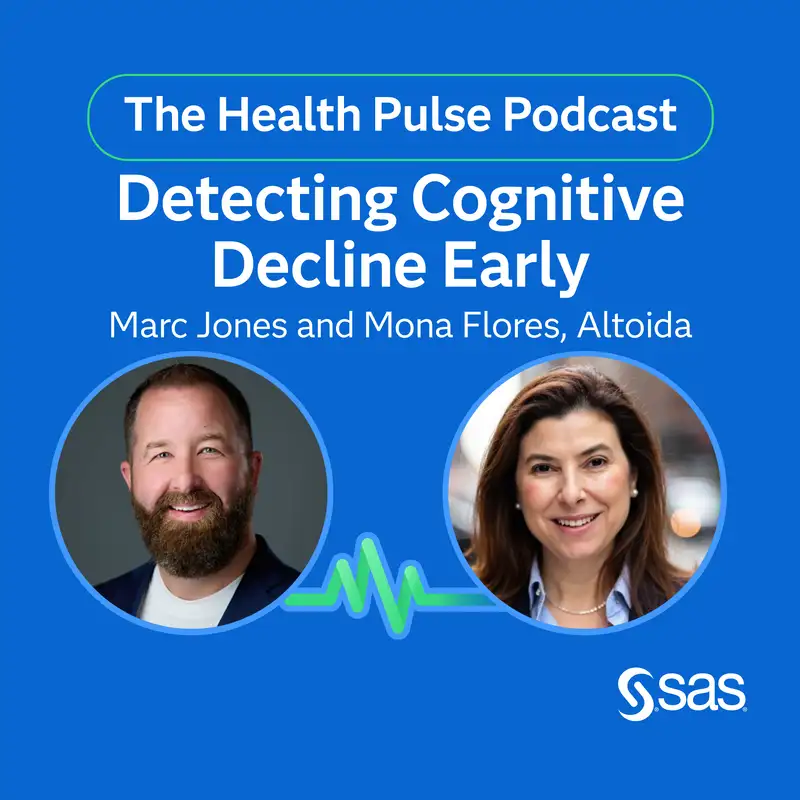
ALEX MAIERSPERGER: There's a societal conversation taking place about living longer while healthier. We've moved from lifespan to healthspan. But our guests today tell us that's not enough, and they have a new word to describe living our best lives. Marc Jones and Dr. Mona Flores join us from Altoida, a company changing brain health by making it easier to detect early cognitive decline.
[MUSIC PLAYING]
Marc and Mona, you've raised hundreds of millions of dollars, collectively. You've supported startups all over the world. Now both of you have left high-profile roles, high-profile companies to join the mission of Altoida. Can you walk me through why and what is it about this challenge, this company, this time?
MARC JONES: Sure. Well, Thank you for hosting this discussion today. It's an honor to be here with my colleague, Dr. Flores. Listen, I think we can be doing a lot of things with our time. And there's a lot of productive things to be doing with our time.
And there are things that have economic value only, and then there are things that have humanistic and economic value. And where you can intercept those two places, I think, is where many people want to be.
And so I jumped into health care early in my career. I'd like to say that I planned it. I wasn't probably that smart. I happened into it. And once I got into it, I really-- I worked for a CEO who used to say, we can do well by doing good. And that really hooked me early on.
And so over the last 20 or so years, I've spent most of my time in health care, and in areas where there were large unmet needs, where a standard of care was being utilized that might not have been intended or designed for that purpose. And we need to do better as the population changes, the demographics change.
And when I got introduced to Altoida, something really grabbed me, and maybe because my grandmother was diagnosed with Alzheimer's and ended up having some other issues that resulted in her passing, and it ultimately wasn't Alzheimer's. And if we had known it was something else that was vascular related, we possibly could have had more time.
And when I got introduced to this notion that leveraging next-generation technology in an accessible platform, we might have the potential to avoid a situation like that, I had to take a look. And then when I met the team and I realized how many people experienced similar things-- and then in my daily life, people deal with this. You don't have to look too far. It was just something that, for me, it became inevitable. And I tell you, I've been proud of a lot of things I've done in my career, but this is at the top.
ALEX MAIERSPERGER: Mona, your experience?
MONA FLORES: Yeah. In a way, it's a little bit similar. But actually, Marc, I just want to say-- what you said earlier about doing well and doing good. And I think that is so important, and that is not present in many different places.
And actually-- in fact, when I was at NVIDIA, I remember Jensen always said something which I thought was great. He said NVIDIA works on three problems. And the problems have to be, first and foremost, good for humanity. They also have to be very challenging problems, and they also have to be problems that NVIDIA is a lone position to do it. If someone else can do it, let them go ahead and do it.
And I think here, when I got introduced to you and what you were doing at Altoida, it's definitely a company that's doing good, and it's definitely a company that is trying to solve a very difficult, challenging problem that is omnipresent. You are right. It's your grandma. It's my parents. It's our neighbors.
There's so much disease today in Alzheimer's and other neurologic diseases. And the older we get, the more we're going to have. And catching the disease early is paramount in order to be able to do something about it, in order to be able to help even just a little bit.
So I think the mission is amazing. And it is-- when I worked before in technology, it was preparing for companies like Altoida to actually take it to the next level and create something for the patients. And being able to actually work directly now in creating a product that will help people, that will help humanity-- I think it's awesome.
ALEX MAIERSPERGER: Well, we're happy that you're with us.
MONA FLORES: Thank you. Thanks for inviting me.
ALEX MAIERSPERGER: You both mentioned that you don't have to look very far, and clearly, I share a personal story of my grandmother with Alzheimer's. Marc, you said just how big the problem is and the challenge that we're facing. In the US alone, millions of people are living with undiagnosed mild cognitive impairment.
And globally, I think you can share the statistics. Many obviously can be helped if it's detected early. And to your point, and I think to my own personal story with my grandma, just figuring out, is this age-related decline-- is this normal? What is this? How do we treat it and deal with it?
How are we going to do that from a detection standpoint and an early detection standpoint? Is this going to be at every primary care visit? Do we need to have a baseline when we're 18 and in the healthiest portion of our lives so that we can measure against? How much decline is normal? Walk me through the future.
MARC JONES: Yeah. Well, they say the journey of 1,000 miles starts with the first step. And we've got a big journey ahead of us, given the size. You alluded to the global issue. There's published data that suggests as many as 180 to 200 million people walking around with undiagnosed mild cognitive impairment, which is the biggest misnomer. It shouldn't be called "mild," because it's anything but mild. This is the earliest diagnosable stage of cognitive decline that's moving you off of normal brain aging.
And there's so many things that get in the way. Is it stress? Is it menopause? Is it some other comorbidity that you just explain away? And because, by and large, the health care system is a sick care system, not a health care system, it's easy to miss those things.
But maybe more problematic is like many disease states, early detection is where we need to be. But if people aren't getting that capability, how are they ever going to improve? And so yes-- like, listen, I would love a world where we're doing baselines early on.
But I also know that we can't boil the ocean today. We need to show efficacy in a particular area for a population with symptoms, and then we can move upstream from that. I think that that's how guidelines happen. We want to test that clinicians will trust that when we diagnose someone, that they can move into the next phase. We can work on this platform to move farther and farther upstream, become a screen. Maybe earlier on in life you start a baseline, and you just monitor your baseline over time.
So ultimately, that's, I think, where technology-- and that's the beauty of technology, is it's ubiquitous. And so it's a natural extension to be able to move upstream. But we're really focused right now on those people that should be-- and when I talk about the potentially 200 million in the US, it's nearly 10 million-- these are people that could be on treatments.
Or if they knew it, they could have modifiable forms that with diet and exercise and lifestyle changes potentially could alter their trajectory. And so technology, I think, has to find its way, because there's too many people and too few clinicians to address the problem on their own.
ALEX MAIERSPERGER: Mona, you've seen this on from multiple angles. You've been in the operating room and in the AI lab. What's the clinical cost of waiting too long for a diagnosis? What type of burden are we placing on both the system and physicians and care teams and on society by not addressing this right now?
MONA FLORES: That's a great question. I think the cost is huge. It's like-- can't even-- it is tremendous. And it is from different angles. Once you are at that stage where you already have the disease and you're having all of the symptoms, the family now is having to make choices.
You're having the kids become the caretakers. You are leaving-- even at earlier stages, you are leaving the workforce, so there's decreased productivity in terms of the workforce. But also, the lost chance of being able to actually intervene, being able to reverse this, or at least attenuate this disease.
I want to give you an example. A lot of-- when I was still operating, a lot of patients would come in, and they needed to have heart surgery. And this is-- I'm talking about people who had like coronary disease. And they would say-- it's like-- they're like woe me. It's like, look, I'm having to have heart surgery, this is awful, what have you.
And I used to tell them, hey, guys, you are the luckiest of the lucky, because, especially the ones that came in with lesions, that we call them like widowmakers-- like lesions that were-- you could be playing basketball today, and you would have a heart attack, and it would kill you right away. These are the people that had no idea that they had disease. They were-- we play soccer, we are very active, we don't have any problems, and then they drop dead.
So the fact that we were-- if we were able to diagnose them earlier, now you saved them. Now you saved them not just from death, but from morbidity and having to live with heart failure later on.
So prevention is amazing, but also detection, as opposed to diagnosing. If you're able to detect disease way earlier when you just have cognitive impairment, you can-- and I'm very hopeful that there will be treatments, there will be protocols, there will be things that will make us change the trajectory of this disease.
You don't just drop off a cliff-- like with heart disease, maybe you do, but not with cognitive health. It's not like one day you are out there speaking and inventing something, and the next day, you have fulminant Alzheimer's. It takes time for that to happen. So the earlier you detect it, the earlier you can change that trajectory.
And with a tool like what Altoida has-- today, if you want to be able to test someone, one, it takes forever to find a neurologist, it takes forever to do the tests, they are very subjective tests, and they are also a point in time.
We all have gotten up one day and we're like-- we got up on the wrong side of the bed, and we're not thinking straight, and we can't find a word, or what have you. But that's just one point. And it depends when you go to the doctor that day what they will find.
But the disease is not like that. It's like, you have to study the whole trajectory day after day after day and see the trend. And that's what tells you that there is something wrong, not just a one-off moment.
And that's the beauty of having a versatile tool that is very easily accessible and can be done very quickly and can be done very frequently. And it's also very accurate and very objective, as opposed to what we have today in terms of tests. So yes, detect as early as possible. I'm a big proponent of exponent of that.
MARC JONES: Yeah, maybe I'll just jump on to that real quick, Alex, and say the other side benefit of early detection-- think about the knock-on effects of what many people refer to as the diagnostic odyssey.
What is it? What is the etiology of this problem? Are we dealing with just stress, or is this something more different? And so you get these multiple handoffs between specialists and doctors trying to figure things out. And sometimes, it may simply come down to stress or some other thing that can be managed at a local setting and wouldn't require a specialist.
But when you've got a limited number of specialists in a massive population, if you're blindly referring all these people, what you're doing is you're gumming up the system, and you're creating blockages that get in the way of people that truly need that care.
So it's accelerating in multiple ways. It's getting people out of that pathway into a better pathway if they're not suffering from a mild cognitive impairment issue. And for those that are, hopefully we're triaging so they can get access to the right care faster.
ALEX MAIERSPERGER: I'm someone that's nervous getting my blood pressure checked or going to just like a basic doctor appointment. And so the thought of surgery scares me. Dr. Flores, I love the idea of, how lucky are you to be in surgery because of the alternative. And so that sort of optimism and hope and just thought process of, if you can find it earlier, you've got a shot.
And so if your other alternative is you don't know and you pass away, and the other are-- the option is you're at surgery and you've got a shot, I think just speaks to the experience that so many of us have with loved ones and those stories that we all have of just, if you can find it a little bit earlier, you've got a shot.
Altoida is pioneering digital biomarkers. Can you break down what that means in plain terms? I know we probably all think about blood glucose levels, A1Cs, cholesterol panels, so just things we measure in clinical visits today. What else do we need to add, will we add, are you adding?
MARC JONES: Hmm, great question. So we do think about things in terms of biomarkers. When we say "digital biomarkers," what we're really talking about are these objective measures of how the brain is functioning.
And this comes from real-world behavior. What our platform is doing is really emulating real-life activities, rather than blood or imaging. In the case of blood, we're taking blood and we're inspecting it and interrogating it to see if we can find something. Or in imaging, we're looking at an image to see if we can see the presence or absence of something.
And just as blood glucose reflects how the body regulates sugar, our digital biomarkers are intended to reflect how the brain processes information. So think about-- what we're trying to do is translate how those brain networks are functioning-- how we move, how we speak, how we remember.
And so our platform-- what we call multimodal platform uses things like motor skills-- tapping and drawing. We look at things like speech and language. We put images up and we ask people to describe what they see. We listen to what they say.
But we also listen to not just the waveforms, but also the complexity. And that's all mapped up against data points that allow us to understand a little bit better how they're thinking and how their brain is functioning. But these are really, really important to pick up and to identify where there's gaps from what a healthy population might look like from an unhealthy population.
And then we use augmented reality, and this is a really formative part of our technology where we find a lot of signal. So utilizing the phone or the tablet, we're placing objects. So it's almost like you're looking at a screen on your phone, and you're placing a teddy bear or a heart in your room, and then you're retrieving those, and we're picking up all of the sensors in that device.
And so what we add to these traditional biomarkers is what we think is a new layer of insight-- continuous, scalable, non-invasive measurement. And that's what's really important. You had mentioned you get nervous going to the doctor. Well, there is that effect.
When people can do things in their own home, there's a term called "ecological validity." It takes away some of that white coat effect, and maybe you get a more natural perspective. So that's ultimately where we want to be able to bring this. The ultimate scalability is allowing people to be able to download an app in the comfort and convenience of their home-- measure that function.
But we also look at this really plainly as complementary to blood and imaging biomarkers, not competitive to. Because we want to help identify the changes earlier, pair those up with the pathological presence, and then be able to move quickly to treatments and then see how those treatments and that patient is responding to those treatments over time.
MONA FLORES: Now, I actually-- I just want to add one other thing to what Marc-- what you said. And when you talk about a biological marker-- and you mentioned glucose, Alex. It's like, imagine if all we had for glucose measurement was something that tells you, yeah, it's high or it's low-- something very crude.
What we are creating here at Altoida is actually the measure-- you're able now to calibrate. You're able to not just say, glucose is very high or very low. You're able to say, no, it's 195. Oh, no, it's 80. It's 110. So it actually gives you way more information that you can also track over time because it's a very sensitive way of telling if there is a change that's happening.
So it is-- it's just changing the whole paradigm of how do we evaluate neurologic disease, because today, it's so subjective. And it's like, one neurologist might give you a score of 10. The other one might give you a score of 12.
On a good day, you might do 15. Another day, it's like, oh my God, let's do 10. This is actually a new measurement system. You're creating the scale to be able to measure this disease. And I think that's how I define this biological-- digital biomarker that we're creating here.
ALEX MAIERSPERGER: Really exciting. You've both talked about the power of longitudinal measurement and just tracking change over time being so critical in brain health. How does AI, or is AI making that possible where traditional tools can't? Is the magic in, you have the amount of people with these new biomarkers, and you're able to flag the ones that otherwise couldn't be found, or is there magic in all of it?
MARC JONES: [CHUCKLES] Well, I'd like to say that there's science in all of it, but I take your point. I think AI has really enabled the rapid assimilation of complex, discrete data points and identify patterns that otherwise would take a very, very long time in populations.
And when we think about almost anything in life, track yourself-- where was I early in my career? Where am I now? Where was I on the beginning of my fitness journey? Where am I now? Where was I in my retirement planning? Where am I now? These posts or markers help us understand whether we're on track or off track.
And in many places in life-- I think about just the other day running errands, and I looked down, and I hadn't been paying attention. I almost ran out of fuel. We have-- imagine if our cars didn't have accurate fuel gauges. Imagine how crazy life would be.
But what's funny is, in health care, so often, we rely on measures that are subjective, not objective. And as Mona mentioned, you could talk to one trained expert-- neuropsychiatrist, neurologist, specialist-- and get different opinions.
And part of that could be even the cognitive load that they've undergone during that day. How many patients can you possibly see and be fresh at? And so we want to arm them with tools that can allow them to operate at the highest level of their capability and affect more people.
And so a technology powered by AI, I think, is-- maybe it's not a silver bullet, but it certainly is a force multiplier in giving the tools that allow these clinicians to make objective choices, see trends over time. And I think the power of AI is just being tapped.
Imagine a world where we're starting with this assessment, but then because of the power of AI, we can do things like identify the phenotype of this patient, create digital twins, forecast where their brain is going. Then, based on the interventions, the clinician has determined, which maybe has been powered by recommendations from AI-based tools, we're getting like a flash into the future that we can keep tapping against. This isn't working. This is working.
And then what's even more, all those data points on what's working and what's not across various phenotypes is information that can be utilized for future drug discovery and development. It just becomes a virtuous flywheel, from my perspective.
MONA FLORES: You can't fix something if you can't measure it. And you're starting here by being able to measure this disease from its onset before it's a disease. And then you recognize all the patterns, and now you're able to intervene. You're able to develop new drugs. You're able to even predict the trajectory with digital twins of what this patient is-- what's going to happen to them if they continue on this trajectory. So you need to measure something to be able to change it.
ALEX MAIERSPERGER: Your analogy hit home, as my car in college did not have a working fuel gauge, and it was wild. And there were some misses in that. I thought I calculated it right and came up a couple miles short in places. And so it is sort of flying blind.
The analogy, I think, was a great one, just thinking through many of us in our own brain health lifestyle examples, as you really don't where you're at compared to what you know of so much other portions of your life. Really excited to dive in a little bit more of what that means on the longevity side and societally.
We talked a little bit about longevity, and we talked about it in your exercise and some of your dietary choices. It seems like society overall is obsessed with lifespan right now. I think I've heard a few of the headlines that the age 160 is thrown out as a threshold of, if we can just make it to 160 years old, then it's a proving ground to get to whatever number we want.
Is this whole longevity movement and healthspan that's thrown into it of, you need to live healthier years versus just pure more years-- is this a magic preventive pill? Is it a treatment, a protocol for how to build brain health? And is this even the right way to think about longevity from experts in the cardiovascular and brain health world? What are we thinking about longevity?
MARC JONES: Well, I'm going to defer to an actual medical doctor to go first. And then if I can add any value at the end, I'm happy to.
MONA FLORES: Yeah. thank you, Marc. It's interesting-- you said "lifespan," and again-- and you also said "healthspan." And I think that more and more, we're seeing people gravitate towards "healthspan" rather than "lifespan." Because again, if you're 160 years old and you can't do anything and you can't talk and you can't, what's-- again, it's a personal judgment, but in my judgment, I don't want to be alive at 160 if I'm not functional.
But you ask if it's a pill, if it is a protocol, if it's a diet-- I think it's all of that. I don't think there's going to be-- it's not a magic wand that's going to say now humanity-- the average age is going to be 115 or 160 or whatever. It's going to be a combination of many different things.
And the beauty is that today, we have the tools to be able to actually figure out what is it that you need to do to live healthier, longer. Being able to use all of the data around us and all of the new digital tools and being able to figure out the trends using AI from all of this sensor data that we're getting and other data-- we will be able to find answers.
We will be able to find what is the optimal amount of protein that you need to eat to keep your muscles. Like today, if you go and check, look, how much protein should I eat? I bet you you'll find 100 different people saying 100 different things, because there's a lot of things that we don't know. But again, we have the tools to be able to figure that out. And once we do that, then we'll be able to actually bring in treatments, bring in new ways of living, new insights so that people can actually stay healthier.
MARC JONES: My answer is what she said, maybe with a parenthetical. Of course, it won't surprise you that in the argument between lifespan and healthspan, I'd like to advocate for brain span. I was on a conversation recently with someone, and this question came up.
What's more important, healthy body for 100 years or a healthy brain where the body breaks down first? And I think most people would choose a healthy brain, because that is more quality of life.
So we need to make sure that in this whole thing, we do contemplate brain span, because that, I think, is-- that's where our spirit and that's where our ability to interact, communicate and love and laugh and live-- that's where it comes from. And so that would be my focus, in this aspect.
And the cool thing, is I think a lot of those are interchanged. So the things that you do to help out with healthspan, it turns out, not surprisingly, can positively impact brain span as well.
MONA FLORES: 100%. Can I just add one thing to that, just almost anecdotally? When I was still practicing, the joke was-- it's like, what's more important, the brain or the heart? And of course, at that time-- and I'm like, the heart is more important.
And I can tell you with utmost conviction now that it is the brain, because you can't have a heart. You can't have anything. You can't have love. You can't have life if you don't have a brain. So brain span it is.
ALEX MAIERSPERGER: I love the evolution from lifespan to healthspan to brain span-- really important distinctions, and really important thought process for society at large. You've both built and supported companies. I hear one thing from physicians lately around AI. It's, how can we tell what's real and what's not?
And whether it's at the individual physician level or the hospital or health system level, is this a wait and see what the outcomes are approach? Or how can hospitals, health systems, individual physicians looking to make life easier for either their team members or their patients-- is there something they can do to more fully be engaged in the technology revolution?
I know on the LinkedIn side, if you say you're a physician on LinkedIn, you get hit with 1,000 messages. And I've seen friends that it's like, I have this AI app. I've got this thing. Will you be an investor, advisor? Can you help put this in your hospital? How can they be most fully engaged in this AI future?
MARC JONES: Hmm. Well, interestingly, some of the fastest adopters of AI are health systems. There's been recent reports showing, from an investment perspective, health systems are making massive investments in AI.
And it might surprise you-- maybe it won't surprise you or the listeners that administrative functions are among the leading. Now, you'd say, well, if we could use AI to solve cancer or solve heart disease or neurological disorders, why are we focusing on administrative functions?
Well, it turns out that there's a lot of functions that pull clinicians away from what they're trained on, what their highest and best use is, to help patients, into administrative things. And the thing I do like about that-- I would say it's a low-risk proposition, or a lower-risk proposition for health systems, because this black box AI concept is maybe less of an issue when you're dealing with administrative functions.
So I think that that's a great way, because if we can allow doctors to practice and not spend hours and hours and hours when they should be resting and enjoying life putting their notes into EMR systems, I think that's a net benefit for the doctor and for the patients for the next day.
And then separately, I think industry-- and I think regulators like FDA are working really hard to demystify some of this black box AI perspective. How do we get from broad populations of people to data sets to diagnostics? And being able to walk that channel and explain how we utilize those things, I think, are really, really important, and it's certainly something that we're doing at Altoida.
ALEX MAIERSPERGER: You both have helped me imagine a world where digital biomarkers, AI-driven diagnostics are fully embedded in care. And so I can feel the future closer because of what I've learned from both of you, and just the personalization of going through and understanding my own brain span and my own lifestyle and how it's impacting my healthy years that I've got.
I think the challenge is, I don't feel the change yet. And I think many of the listeners-- you're out there, and you hear "AI" and "personalization" and all these things, and you say, when I went to the doctor last, I still fill out intake form with a clipboard. And I still repeat myself and ask for labs to be taken at appointments, and I still have to advocate for myself and do these things.
When will people feel the change in the health care system? How far are we from having this at every primary care visit and having this at our fingertips to be able to use at home and judge ourselves against and have these posts that we know?
MARC JONES: Well, often, things start like a breeze and end as a gale. These things-- it takes time, particularly new technology. We're sitting here in 2025. I'm old enough to remember what life was like before email and internet and how we used to communicate. And now, can you imagine life without that technology and how it's changed and how it's evolved?
It didn't happen overnight. It happens with steps. And I don't think it's going to be any different in health care. I think that it starts off-- there's always going to be the companies like Altoida and others that are pushing innovation. There's always going to be early adopters.
What I'll tell you is, from our perspective, it's getting through the process of regulatory approval, getting real-world evidence. It's a constant gentle pressure of more evidence, more data, more support. Because there's always going to be a clinician, a clinician group, or a health system that wants just a little bit more data, a little bit more proof that this is going to provide the benefit that's intended.
Because guess what? In the last 40 years, there's been lots of promise, and not all that promise has been delivered. And so I don't blame some of these systems for being a little bit cautious. I do think that we're-- with the quantum compute and the capability of AI, I think that we're just at the very beginning of a very steep curve where we'll see some dramatic exponential change that ultimately, I hope, allows longer, happier, more successful lives, better outcomes for humanity.
And at the same time, new companies will start because they see, hey, you know what? We can use technology to improve this area of life or that area of life. And here's an analog. Let's look at what Altoida did. Look at what NVIDIA did. Look at what these other companies did. We want to make a difference like that. So I think that this is an ecosystem that will take some time to perpetuate.
MONA FLORES: Yeah, I can't agree more with you, Marc. You know what the saying-- you eat an elephant a bite at a time, but you also need to know what bite to start with. And I think-- when AI came, when people started talking about AI in imaging and what have you back in 2012 and '13, there was a lot of hope that all of a sudden, the next day, we're going to be able to diagnose cancer just from a CT scan and unqualified.
And while we're able to do a little bit of that now, I feel there's a lot of applications that will make patients' lives easier, and these are being adopted-- being able to schedule things in a smart way or giving you recommendations or following up on your vaccinations or things-- you have to start somewhere.
And I think that the systems that are wanting to use AI are starting there. You just have to make sure that you know what you're buying. Not every shiny object out there makes sense. You have to make sure that it is actually solving a problem for your clinicians and for your patients, because otherwise, you really don't need it.
You also need to have your clinicians' input into what's being built and what's being used. Just like-- Marc, you mentioned how some of the things that were promised, like even the EMR that just created so many headaches, when in theory, maybe it was a good thing. So you have to make sure that whatever you introduce is something that people want to use because it's helping them.
And you also-- the proof is in the pudding. Yes, you need real-life evidence. You need to make sure that whatever you build is actually producing the results that you want. And you want to be able to pivot if it doesn't, and you want to be able to always validate these things that you are using, because things can drift.
So just having an open mind and bringing everyone to the table to solve real problems-- I think we will see way more adoption of AI in the future. And if you just wait on the sidelines today, you've lost the game, because others have gone way further ahead.
MARC JONES: Yeah. Hey, Alex, one other thing that Mona made me think about is she was speaking-- there's so many constituencies. I think a lot of times, it's a technology in search of a problem. Or maybe you're going after a problem, but you're solving one component.
And when we look at this landscape, remember, we do have clinicians, we do have patients, we do have payers. We have to solve-- solving only one problem often doesn't get adopted. And so that's why we proudly bring on folks like Dr. Flores and Alzheimer's patients like Mike Swindell.
We want to hear the voice of the patient. We want to make sure that our platform is infused with real-world experience so we're solving as many of those real-world problems as we can. And I think that more companies, more technology companies that do that will find that they're hitting the center of their target more often than not.
ALEX MAIERSPERGER: You have made it to the speed round. So we've put you on to some tough and challenging questions so far. You've had to predict a little bit of the future. You've had to use some medical terminology. Now you get to answer, are you a morning or a night person? And so Mona, we'll start with you, and we'll just get some quick-hitting questions for both of you. Mona, morning or night person?
MONA FLORES: You just want a one-word answer?
ALEX MAIERSPERGER: Yeah.
MONA FLORES: Morning.
ALEX MAIERSPERGER: Morning. You can qualify it if you want. We do have-- if you have to.
MONA FLORES: I used to-- biologically, I'm actually a night person. I just got trained to be a morning person, and now I'm a morning person.
MARC JONES: Morning, morning, morning. I like doing it when everybody else isn't.
ALEX MAIERSPERGER: Love that. Favorite way to exercise?
MONA FLORES: If I could, it would be skiing, but what it ends up being is walking. [CHUCKLES]
MARC JONES: If I could only pick one, it would be road cycling.
ALEX MAIERSPERGER: Walking and dreaming of skiing, and then road cycling.
MONA FLORES: Downtown. Yeah.
ALEX MAIERSPERGER: What's your favorite app on your phone?
MONA FLORES: No, it's actually an older app that I just rediscovered. It's Duolingo because now they do chess, and I am just addicted. I am learning all these chess tricks that I never knew, so I love it.
MARC JONES: Real Free Solitaire because it's free, first of all, and-- I don't know. It's a calming thing for me. I just love playing solitaire on the phone. I probably do that more than anything else on the phone. And maybe I'm channeling some brain activity that I'm trying to prevent future issues.
ALEX MAIERSPERGER: Yeah, I think both of you went the brain health route-- chess, language, and solitaire. What's one place you haven't been that you'd like to go?
MONA FLORES: Many. I can't even begin. There's just so many. Someone earlier mentioned Iceland. I've never been. Love to go see it.
MARC JONES: I would love to do a cycling tour in the Dolomites in Italy. It just looks beyond comprehension, the beauty.
ALEX MAIERSPERGER: I would choose the car tour for that one. I've seen the-- beyond comprehension on beauty and on sheer size of mountain. This one takes you on the opposite side of what's your favorite exercise, and is a controversial question for most guests of, what is your favorite ice cream flavor?
MONA FLORES: Oh, I am just so plain. It's chocolate, chocolate, chocolate every day.
MARC JONES: I'm going to go with mint chocolate chip.
ALEX MAIERSPERGER: Both excellent choices. There's nothing--
MONA FLORES: I actually hate that flavor, Marc. I cannot stand mint chocolate chip. [CHUCKLES]
ALEX MAIERSPERGER: And I told you, this is the most controversial of questions.
MARC JONES: I still love you, Mona.
MONA FLORES: I know. Me, too. Love me, I mean, I'm sorry. I'm just teasing.
ALEX MAIERSPERGER: Back in the hot seats. Thank you so much. Got to know you a little bit better. It's always a fun portion to hear life outside of all of the mission-driven work that you do. And from what you shared, this is as big of a real-world problem as there is.
And so thank you both for working on it, Marc and Mona. Thank you so much for being here. Incredibly supportive and meaningful, the conversation of your mission and of the company. I think next time that my loved ones and I interact with the health system, we're going to be asking for Altoida, so thank you.
MONA FLORES: Thank you, Alex.
MARC JONES: Thank you so much.
MONA FLORES: Thanks.
ALEX MAIERSPERGER: Thanks for joining us. If you'd like to leave comments, join as a guest, or have strong feelings about ice cream flavors, please email us-- thehealthpulsepodcast@sas.com. See you next time.
[MUSIC PLAYING]
I want to keep going just to add like, I now have all the curiosity questions.
Creators and Guests