Using Wearables and AI to Detect Disease Earlier
RICKY BLOOMFIELD: So we found that with an Oura Ring, we could detect COVID 2.75 days earlier than someone would otherwise find out with a COVID test. That's pretty remarkable. Because if you have almost three days early warning that something is going on, you can take action to stay home. You can try to get some rest, take some medications. That's really powerful because you can reduce the likelihood that other people will get infected.
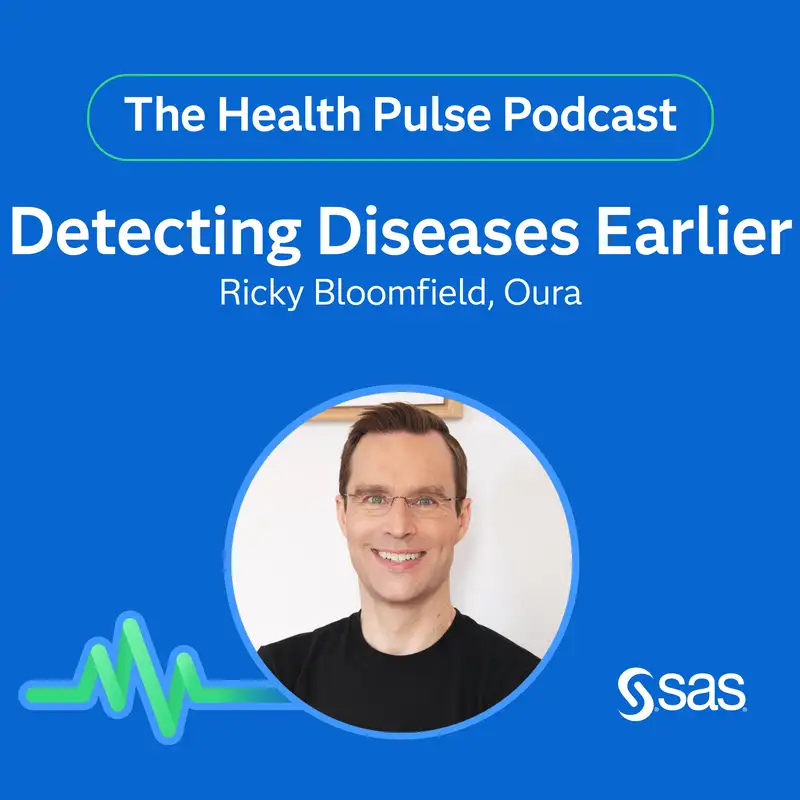
ALEX MAIERSPERGER: Today, you're going to learn what you should be sharing with your doctor from your wearable device, and how the form factor for wearables in the future may be different than you think. Hear it from the Chief Medical Officer of Oura, Dr. Ricky Bloomfield.
[MUSIC PLAYING]
The precursor to wearables was probably phone apps, including condition specific apps. So this is something that you've also had a big hand in shaping. So going back to the clinical career, was there an aha moment that took you from the bedside to the tech side where you're like, oh, I saw this app, now I'm going all in on this thing? This is going to be the future. Did you foresee this shift before others or was it just sort of natural career progression?
RICKY BLOOMFIELD: Yeah. I mean, we could probably spend a lot of time on this. But when the iPhone first came out I was actually just about to start my residency. So I started residency in the summer of '08, and the iPhone came out in '07. And so I was watching that happen at the time, when the App Store had early medical apps like Hippocrates and things like that.
And so that's actually literally why I'm here today and doing what I'm doing, is because at that time, I knew that everyone was going to have a computer in their pocket at some point. And so I taught myself how to write iPhone apps, and that kind of is what changed the trajectory of my career.
ALEX MAIERSPERGER: This was like, nights and weekends? Like, I'm going through medical residency, I'm a physician, and I'm also writing-- like, teaching myself how to write iPhone apps?
RICKY BLOOMFIELD: Exactly, yeah. So when I started this, I actually had just finished my intern year in my Med Peds residency. And so in my second year, I started my PICU rotation, so the pediatric ICU. And that was the month I started teaching myself how to write iPhone apps.
So that might seem strange, but for me it was interesting. Because using-- it was a very different part of my brain that you're using writing apps versus the type of thing that you do clinically. And so it was relaxing for me to come home and just solve puzzles by writing code and actually building things.
It felt very constructive that you're putting something together and creating order, whereas in medicine it feels like there's so much out of your control all the time that it was just very therapeutic to learn how to write code. That's probably not how most people would describe it, but it was-- I guess you had to be there. It was the moment I was in.
ALEX MAIERSPERGER: Most of us relax with trashy TV.
RICKY BLOOMFIELD: There you go.
ALEX MAIERSPERGER: IPhone apps-- I'm still trying to unlock that part of my brain that relaxes with something meaningful. So you went from writing iPhone apps to shaping iPhone apps and worked at Apple. Tell us about the Apple to Oura story. What drew you to Oura and to this space. And maybe it's similar space, so maybe the better word is form factor.
RICKY BLOOMFIELD: Yeah. I was not looking for a career change, so Oura approached me. And initially, my first thought was, I'm very happy at Apple. There's still a lot of work that we need to do. But the person who approached me, I had worked with previously, and so I had a lot of respect for him and said I'll at least listen to what you have to say.
So I spoke with a few folks, and that's when I started realizing that there were actually a number of self-imposed barriers that I think we had at Apple, that at Oura we did not have. And so some of the obvious ones are that Oura is cross-platform, so you have iOS and Android. And one of the big challenges has always been partnering with organizations is always more challenging at Apple because you're going to someone saying, we have a solution for you.
But it really only solves half their problem, because they still have the other half of their patient base or population or whatever it is that doesn't have an iOS device that they still need to find a solution for. So then they're forced to come up with a different solution for that side. And then they have this heterogeneous platform in their health system or clinic that they then need to manage.
And so when we can take a cross-platform solution to them that solves their problem for everyone, that's much more satisfying and actually easier from a CIO perspective, from a CMO perspective. So I realized that. And then I also started looking into the benefits of the ring form factor. And what I realized is it's actually a much better place to do this sensing than the wrist for a number of reasons.
Number one, you have actually a couple of arteries that run along the bottom of your finger called digital arteries. Digital as in digits, not digital as in electrical. And we can actually pick up some of that arterial signal, which gives you a stronger signal, which means that the PPG waveform has more features in it that you can then use for the machine learning models that we build.
But also, just the fact that people are more willing to wear a ring at night. And of course, that really matters because night time is when you get the best signal. You don't have the motion artifact of us flailing our hands around during the day, and the change in temperature and everything else. It's just a much more challenging environment during the day than when you're at night, which is typically a pretty stable, controlled environment when we're sleeping, both from a temperature, noise, movement, all of those things.
And realized that we just get much better signal, better compliance, all these things, and that when you pull these together, if the vision is how do we help improve health at scale in the 99.99% of the time that you're not in a doctor's office and you're not in a hospital, a device like the ring, Oura Ring, is just much, much better positioned for that. And that's when I realized, if I want to make the biggest impact to as many people as possible, I think Oura is the best place to do that.
ALEX MAIERSPERGER: That sound is a bunch of people running out to buy Oura rings.
RICKY BLOOMFIELD: I'm not here to sell rings. I'm here for the science and the clinical part. There are other people that can sell them. But when you have a great product, it kind of sells itself, which is one of the benefits.
ALEX MAIERSPERGER: You talked about the opportunity to scale real health. And I think that relies on behavior change. And so let's talk about episodic care to continuous monitoring and what that does. I had a CFO of a health plan once that we were talking about all the sort of policies and all the health programs that we have, and what was really going to move the needle for making people healthier in short-term and long-term. And his take was essentially the math is the math.
It was kind of all the money that we spend on these health programs, we could save the money that we spend on the health programs and just underwrite the risk and roll with it. He was like, we don't really need big health plan buildings full of people trying to call our members and figure things out. The math is the math.
How important will continuous monitoring be? Having a real rich history of your heart rate and variability and all the other things that it can track-- all of these signals that we have is the highest value in the long-term research that we're going to learn from this? Is it in the individual that sees something and that goes to the doctor early? Or is it something completely different?
RICKY BLOOMFIELD: The simplest cop out answer is yes. And the reason is I think there are a lot of-- a lot of those things will be valuable in the future. But also, this is so early that we don't fully know the answer. So I can tell you what I think today. And number one, we have to focus on the individual and on the benefits to their health, first and foremost. If you're not doing that, then you're missing the boat on everything else.
And so when we have features like Symptom Radar, for example, if those of you that wear an Oura Ring have probably heard of Symptom Radar, which is actually a feature we developed during COVID. And so we found that with an Oura Ring, we could detect COVID 2.75 days earlier than someone would otherwise find out with a COVID test. And this was a study we did with UCSD.
And that's pretty remarkable. Because if you have almost three days early warning that something is going on, you can take action to stay home. You can try to get some rest, take some medications like Paxlovid, other things. And that's really powerful because you can reduce the likelihood that other people will get infected.
And what that's really doing, what that feature is really doing is actually looking at your baseline vital signs over time, because the ring knows you so well, because you've been wearing it consistently for months at that point. And then we can tell you when you're having some sort of deviation from that baseline set of vital signs. And of course, there are many things that will do that besides COVID.
And so what we found, since we released this feature a year and a half ago, is that we've uncovered many other things, like multiple cases of lymphoma, multiple cases of appendicitis. And these are all members that have shared these stories with us or shared them via TikTok or Reddit or Instagram where we've learned about it. And in all of these cases, all of them likely would have gotten to that diagnosis at some point in the future.
But when they had the ring that was just like a check engine light on a car telling them earlier, hey, something is going on with your body-- they were getting a notification in the app that said, major signs of strain. And when you have that early warning, time matters. Time matters for lymphoma. Time matters for appendicitis. You don't want it to rupture. And so all of these people were able to get in and get to a diagnosis, with their doctor earlier than they otherwise would have.
And so it's stories like that, that really confirm that we're on the right track here. So you have to start there. You have to start with the individual. But then, over time, we actually want to quantify that. The anecdotes are incredibly powerful and they keep us going, and we just keep seeing those week after week. But we also want to make sure that we're actually measuring the improvement to health, and not just measuring the improvement to health, but also measuring the cost savings.
And you can break that down further into the cost savings to whom. Is it to the patient? Is it to the provider? Is it to the insurer? Because as you and your listeners know, health care is really complex. And sometimes the incentives aren't aligned that just because you save money, that might not be enough for whoever's paying because it doesn't save the right people the right amount of money for it to be worth it to them.
And that's some of the complexity that we have to deal with. But that's why I have a team that's focused on clinical outcomes research. And I'm not aware of other wearable companies that have teams dedicated to nothing but measuring the outcomes of the interventions that happen because of the device. But that's really important to us.
And as we learn more about that-- it's still early days. I don't have a list of things that I can tell you right now because we're starting this work. But as we learn and as we publish those results, that's really what's necessary. But we're really optimistic about what we can do because of these anecdotes. The anecdotes are the signal, the hypothesis generation type event that then helps you go in a direction where you can get even more objective data.
ALEX MAIERSPERGER: So you talked about meaningful measures and metrics, and you've got a team working on it. Are there some early signals of what's clinically meaningful from a signal standpoint? Is there something you'd want everyone to be sharing with their doctor now versus, hey, this tells me I'm a little bit off baseline? Is there something that stands out as like, everyone should be sharing this metric with their doctor?
RICKY BLOOMFIELD: Yeah. There are a number of really interesting signals that we're already seeing and that we've built into the app experience. And so we have the basic scores, your activity, sleep, and readiness. And that that's a useful early indicator that something is going on. And people use that to help improve their sleep.
But one of the things we saw is that having the daily score is only one part of that equation. And what would happen if you actually had a cumulative score? So just recently, we released a feature called Sleep Debt, which actually tells you your cumulative amount of sleep debt. If this was a bank account, you're making sleep deposits and sleep withdrawals. And so over a certain amount of time, how much are you accruing?
And so for example, if your sleep debt is 30 minutes, that's something you might be able to make up in an evening. If your sleep debt is 10 hours. That's a very different signal that, hey, you're having a problem getting to sleep on time. It's not something you can just make up by sleeping in on the weekend. And it changes how you approach this, and also gives you a stronger indicator that you're just not on the right track in a way that looking at the daily score won't give you. So that's one example.
Another one is the Cumulative Stress Score. So the Oura Ring actually gives you-- every 15 minutes will give you a stress assessment. And this is physiologic stress, not mental or emotional stress, because that's a very different thing to measure. But they can correlate.
And what we did was we actually built a machine learning algorithm that looked at your individual stress scores and didn't just add them up, but we actually built a score that we correlated with the Perceived Stress Score and the Copenhagen Burnout Inventory, so basically standardized scales to measure this type of stress and burnout. And then we provide this Cumulative Stress Score. So you can actually see over time. I believe it's over a month or so where you're at, if your stress is high or if it's low.
And again, that cumulative signal is so much more powerful to you than just looking at day by day or minute by minute. And then the third example I'll give you is Cardiovascular Age, which is another longer term metric that you can see in the Oura app. And this is actually a metric that is derived from something called Pulse Wave Velocity. And Pulse Wave Velocity is a measure of large artery stiffness.
So think of your aorta, your carotid arteries, your femoral arteries, your brachial arteries, kind of the big pipes that feed blood to your body and extremities. And the reason that's important is typically, when you're younger, you're healthier, these large blood vessels are actually very contractile. They're very elastic. So when your heart pumps they get bigger, and then they actually contract and actually continue to help squeeze the blood throughout your body.
And if you don't use your heart as much, you don't pump as much, and they're not exercised as much-- or if you have atherosclerosis or other reasons-- then these blood vessels aren't as elastic. They're much stiffer. And so that can give you a measure of your what we call cardiovascular age. And so we built an algorithm that actually compares your individual cardiovascular age based on this Pulse Wave Velocity with your peers of the same chronologic age.
And so of course, as you can imagine, that results in some interesting outcomes. We actually have people at Oura who have looked at their cardiovascular age-- and it's presented to you in years. So for example, your cardiovascular age is plus 8, meaning it's eight years older than your peers of the same chronological age. Or its negative, which means eight years younger than your peers.
And we've had people where it's been higher, meaning they're older, and that's the signal that they need to change their behavior, to start exercising, to really get on the bandwagon with their diet, with their sleep, with other things. And the best part about cardiovascular age-- it's a slow moving metric. But if you start exercising and exercise regularly, it will start improving. It'll start coming down as your heart beats more, as you get that longer term cardiovascular exercise.
And that is immediately reinforcing that you are doing the right thing. And there are so many people who have seen that pattern. They saw it was high or higher than they wanted. They started exercising. It came down, and then that reinforced the behavior, that, number one, it motivates them to do the right thing. Number two, it increases their trust in the product, that the ring is actually measuring something real because they had an impact on it and were able to see that impact.
So at the end of the day, we can give you all the data in the world, but what matters is are you doing something about it. And so these three examples that I gave are ways for us to actually show people and motivate them to actually make that change and do something about it to improve their health.
ALEX MAIERSPERGER: Can I declare health bankruptcy, where my sleep debt and my exercise debt gets wiped clean and I get to start over at some point?
RICKY BLOOMFIELD: Fortunately, it does not look back until your date of-- the day you were born or the day you started wearing the ring. So it kind of only looks at the last 30 days. And so if you focus on being healthy for two weeks, 30 days, then basically it's like declaring bankruptcy in some ways, at least for those metrics, and gives you a chance to start over. And that's important.
I know you say that partially as a joke, but we actually-- one of the things that I love about the Oura Ring is that many other wearables just tell you to do more, and more, and more. Get more steps. Exercise more. Close your ring a few more times all of those things-- it's always more. It never really tells you, you need to take it easy today. You need to back off.
And the Oura Ring does that. In the app it'll say, hey, it looks like you really pushed yourself yesterday. Why don't you consider taking it easy, because your Readiness Score is low or other things. And sometimes, especially the go, go, go type people, the type A personalities need permission to say, hey, it's OK. You can take the day off. And, in fact, taking the day off from all the things you normally do is actually the healthiest thing for you.
And sometimes we don't give ourselves that permission. And traditional wearables, many of the wrist-worn wearables, also haven't really given you that permission. It's all about meeting these goals every day, don't break your streak type thing. But looking at health holistically is more than that.
ALEX MAIERSPERGER: I love that. And it's really a long-term view, and so it's not just, hey, you woke up again today. Here's the things you've got to do. It's, hey, over the last month, this is what's going on with you. Here's some of the things that will help in the next month. What a great way to look at the health of an individual.
You mentioned AI a couple times, if we're creating these algorithms we're using machine learning. How is AI used to interpret wearable data today, and where do you see that going in the future?
RICKY BLOOMFIELD: Yeah. When people today say AI, I think they're generally referring to LLMs large language models. Of course, AI has been around a long time, and we've used AI in the form of machine learning since the very beginning of the company 13 years ago, because that's what you need to interpret these physiologic signals from these sensors that are producing data every second. And so we build models that help us understand what is your heart rate, what is your HRV, your blood oxygen, all of these things.
But AI today, it does have a slightly different meaning. And these large language models or LLMs have changed, in many ways, how we can interpret the data. And one of the reasons is because there are just so many different data streams coming at us, that trying to build some sort of-- we use the word deterministic, meaning you basically build a set of rules that if, or else, take the right path or the left path or whatever it is you might build. And those systems can get really complex, really fast.
And they're what I call very brittle systems, meaning those systems can't handle the complexity of a human that has dozens of different data sources coming in, and all of the permutations of different data inputs are just impossible to completely model with that type of system. And so that's one of the things that LLMs can do today is they're actually very good at taking all of these different inputs and trying to make sense of them in a way that would be very hard for a deterministic system to do.
And so, of course, we have Oura Advisor, which is one of the paths that we use. So it is an LLM-powered system, so it uses AI and it can query your Oura Data that you have in the app and you can ask questions about it. And we think this has been really powerful because it's infinitely patient. You can ask as many questions as you want. It doesn't get tired. We've designed it to be very supportive and non-critical, but it also gives you the information when you want it.
And so it's really opened up a lot of opportunity for people who might not want to talk about these things with another human. You can really lower the barrier of entry when it's this non-judgmental tool, advisor that can help you figure out what's going on.
ALEX MAIERSPERGER: There's a lot of blurry lines right now between wellness versus medical device, there's longevity, whatever you sort of want to call all of these categories. What needs to happen for wearables to be integrated into healthcare? There is still a little bit of a feeling, and I think you hear that anecdotally too-- hey, I took my doctor this heart rate and they immediately sort of dismissed it, or I took this and this score didn't really show up. It doesn't show up in my medical records. What needs to happen for it really to be integrated into the way we experience care?
RICKY BLOOMFIELD: This is something that we've been thinking about a lot, and I thought about this a lot in my prior job as well. Because at the end of the day, if we're telling an individual something important, there are only going to be so many things that they can do themselves. And at some point, they're going to cross that threshold into needing to talk to their doctor.
And if we really care about the health of a whole individual, then we need to have those options available. How do they take this to a doctor? And when you do that, having been on the clinician side of that as well, you don't have a lot of time to spend with each patient, certainly not as much as most doctors would like. Because the economics are really challenging in health today, and burnout is rampant, of course, as well.
But because you don't have a lot of time, the last thing many doctors want is for someone to come up and just dump a spreadsheet of data down on their desk and say, hey, make sense of this for me. I'm not sure what's going on. Because chances are, they just don't have time or the resources to make sense of that either. And so what we know we need to do is both make the data understandable to the end user, but then also summarize that in a way that is meaningful for the doctor, so the doctor knows exactly what's important and what is actionable from a clinical point of view.
And some of the work we've done in that space include partnering with organizations like Essence, which is a Medicare Advantage plan in the Midwest US. And Essence actually provides the ring as a covered benefit for their beneficiaries. And that is something we started with them a year and a half ago, and it went so well last year, that this year they're opening it up to all of their other lines of business.
One of the things that we're working with them on is how do we make sure that when those Essence beneficiaries opt to share their data with their doctors through their Essence plan-- and it is optional. All of this has to be at the user's control, in the control of the patient or the member. Then we want to make sure that it is done in a way that gives the clinicians exactly what is important.
And so they're very interested in these metrics. How do we summarize it in a way that helps them understand what's going on during sleep? And you can imagine that at nighttime, some of the things you're interested in are breathing disturbances, things that might lead to a sleep apnea diagnosis, looking at overall sleep time, looking at notifications like symptom radar, for example, and are there conditions where that can matter more than others. And so we feel that it's our obligation to work with these clinicians, listen to them, listen to their medical advisory board to get that feedback, to make sure we're doing this the right way and not just inundating them with a bunch of data that they don't need.
ALEX MAIERSPERGER: You don't have to give trade secrets for Oura right now, but I think we all see the headlines of there's pills you swallow now that have some measurement component to your gut health. There's stickers or patches on the skin. There's clothing that you see that has sensors integrated into it. Will the form factor for wearables keep changing? You mentioned just the finger of digital arteries versus the wrist. And there's obviously places better on the body that you're going to get more clear signals and more long-term ability to research. Will this form factor keep changing?
RICKY BLOOMFIELD: That's a really good question. And I think if you look at the form factors that have worked today, they're form factors that have actually worked for dozens or hundreds of years. And so when you look at the watch, when you look at the ring, when you look at eyewear, all of these things, none of these are actually new when it comes to technology. These are things that humans have been wearing for a long, long time.
And so from that perspective, I don't anticipate that there's going to be something completely new and novel that will be acceptable to humans. Certainly, you get into the realm of implantables and things like that. We'll see how open people are to that. I think the non-invasive type devices are going to be far more popular and scalable. And there might needs for implantables.
Obviously, if you need a cardiac defibrillator, that has to be implanted. And there are reasons for that. But also we're not going to do that for everyone. And the benefit has to outweigh the risk. But when it comes to getting as many devices on as many people as possible to really bend the cost curve in ways that help from a prevention standpoint, noninvasive is going to be the way to go for the foreseeable future. And the type of form factors that I think are going to work and scale are ones that we're very familiar with.
And fortunately, you have 10 fingers. You only have two wrists. And generally, people don't like wearing things on both of their wrists. But I think the finger ends up being very discreet. And the technology has advanced sufficiently that only in the last decade, decade and a half, that the finger is even viable to do this. Because technology has advanced, battery technology has improved, the sensors have gotten small enough where it's actually possible. And so I think that's why we're seeing some of this evolution.
But I think that most people don't want to wear sticky patches on their body if they can avoid it. CGM gets close. But most people who wear it, either they have a diagnosis of type 1 or type 2 diabetes and they have to. And in that case, it's much better than the alternative, which is sticking yourself with a needle three times a day.
But for people for whom it's not required, generally they end up wearing a CGM maybe for two to four weeks and then they stop. They've gotten enough information in that period of time that very, very few people are going to wear it 24/7 without a diagnosis. And so I think we've seen-- and the market has told us the type of devices that are acceptable and are going to scale.
ALEX MAIERSPERGER: That's a great insight of just the last 5 to 10 years of how we've been able to miniaturize technology, to the point you can have it on a ring now and you can get such rich data. So the next 5 to 10 years, sort of outlook-wise, what role will wearables play in the future of healthcare?
RICKY BLOOMFIELD: It's hard to predict the next 5 to 10 years. I have a hard enough time predicting the next year, especially with AI and how quickly things are moving, because it's really changing what's happening out there. But I do think that, from a general perspective, we're going to keep moving down this path of more prevention-focused, where we can detect things early, let people know.
You might have heard of the Star Wars tricorder, this mythical device that can detect and diagnose anything and can do almost anything from a treatment perspective. And we're getting closer and closer to where these technologies can detect so many different things. And for those that have an Oura Ring, we actually have a feature in Oura Labs. It's actually a study called Blood Pressure Profile, where we can detect if someone has high blood pressure or not.
And this is an IRB approved study registered on clinicaltrials.gov, and something that we're planning to take to the FDA. But we think that that's the early signal that we're starting to see, is that devices like this are going to be able to detect real chronic conditions and likely many different conditions. I think there's still a lot we can do with just this PPG-type sensor, this type of heart rate sensor that shows you this waveform, especially when combined with these machine learning models. There's a lot that we can still do.
And so imagine if there's a device over the next 5 or 10 years that it's your guardian angel. It's sort of watching over your shoulder 24/7 and can detect all sorts of things, let you know early, arrange that visit with your doctor only in the situations where it actually warrants that. And then the doctors themselves are supported by AI tools that help them come to the diagnosis faster, even remotely, where you don't have to go in, and check in, and figure out your parking, and take time off work.
So I think that's what the future is going to look like. And many people have been seeing this over time, but I think the tools and the technologies are now starting to converge that actually make this future realistic over the next five years, for sure. And so that's why I'm so excited to be a participant in this, because I think ultimately it's going to improve health at reduced cost.
ALEX MAIERSPERGER: I think maybe we're all inherently selfish, but I think one of the things that somewhat missed from a health conversation was just population health and all that. It's very abstract of this is going to lower costs in the aggregate. And when you're thinking about that at home watching the TV, you're like, I want health care to be lower cost for me. I don't know about I care about these big numbers. I want this exact medical bill.
And I think the same with health. And so the vision that you've laid out of just the customer obsession that you clearly display from an Oura standpoint of how can we get the individual to understand, to be able to share, to be able to have this rich knowledge and to most importantly, be able to do something about it is such an incredible vision for, it sounds like, the present and the future. And so, Dr. Bloomfield, thank you so much for being here on The Health Pulse podcast.
RICKY BLOOMFIELD: Thanks for having me. This has been a lot of fun.
ALEX MAIERSPERGER: If you want to join our Mario Kart Party or if you want to join as a guest, please email us, thehealthpulsepodcast@sas.com. See you and your wearables next time.
Creators and Guests