Patients as Partners in Cancer Research
STEVE CLARK: It's vital. Cancer does not define me. It does not occupy every waking hour of my day. It could.
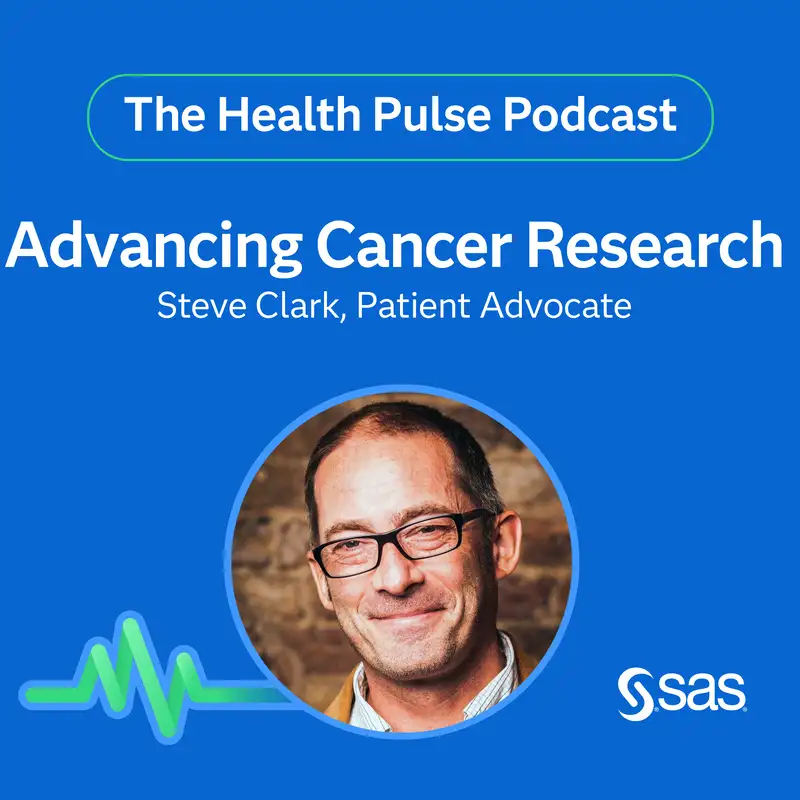
ALEX: One of the biggest buzzwords in the health care and life sciences industries is patient centric. Today, we hear from a patient who says it's time to retire putting the patient at the center and he gives us all something to consider next. Steve Clark is a health care and pharma leader, traveler, dog lover, and 13 years ago was given a 5% chance to live with stage four colorectal cancer. He joins us today to share his perspectives on cancer care for physicians, patients, and researchers.
Steve, before you had cancer, you had a successful career in health and in pharma. What surprised you the most when you suddenly became the patient instead of the professional?
STEVE CLARK: That's an amazing question, Alex. Thank you. For me, one of the big things was that my brain switched off. My ears switched off. So I was in a discussion with a consultant, and I'd done that for years, both as a biochemist and in various roles in the pharma industry. And I'd worked on a global basis working with international opinion leaders in various diseases, speaking to them as a peer. So I'm used to talking to doctors.
But when I sat down in front of a doctor and he said that I'd got cancer and the cancer had spread to other organs, my brain went to mush. And when I was sitting there, the initial conversations I was having about treatment pathway, about different types of chemotherapy they were thinking about using for me, it was just difficult. I didn't hear what they were saying to me properly.
And so I learned quickly to always have a friend with me as an extra pair of ears. That helped. And also to go with a pre-prepared list of questions, which, bizarrely in a professional setting, I never had to do, because I would just have a conversation. But in those early days, and by early days, I mean probably the first couple of years, I had to have my list of questions, because otherwise I'd forget.
ALEX: I don't want to make you relive this experience, but you mentioned just the challenge of not hearing what's presented to you, and I imagine. So you're sitting in that room. You get told you have cancer and that cancer's spread. And it sounds like what they say and what you hear, there's a pretty big gap. What came across to you? Was it the stage of cancer you had, life expectancy? What gets said and what gets heard in that first diagnosis?
STEVE CLARK: It does vary a lot depending on the doctor. My initial diagnosis was given by a gastroenterologist who, I have to say, did really well with me. So I didn't know what was coming. I thought he was going to tell me I'd perhaps got diverticulitis or something like that. The symptoms were pointing more in that direction and that was the instinct I got.
So I actually went to the consultation on my own. And I remember it was on a Friday at midday. And I went into the office and a nurse came and sat next to me, which I thought was odd. And he then, the oncologist, sorry, the gastroenterologist was really good with me. He did say to me, look, this is a difficult conversation. I need to explain to you. We were all surprised by this. It turns out that you've got cancer. And my thought was, oh, God. And he said, and it's spread to your liver and both lungs. At which point my brain just went, that's it then.
And he was talking for a little while, and I didn't hear anything, because my brain just suddenly went into actually a spiral. Because he wasn't discussing, and I know this, he wasn't discussing my prognosis or anything like that, but that was all in my mind. I'm of an age where if it has spread to other organs, that's it. Your number's up. It won't take very long.
But he was actually very good. And what he did, he kept repeating, you're really fit. You're otherwise incredibly healthy. You're the fittest cancer patient I've ever seen. We are going to be aggressive with this. We're going to work with you. And he kept repeating this. And that actually started to go in. So I did start to hear it. But I could only take in so much on that.
But I know the difference between what happened with me and what happens with many others, it was quite extreme. A lot of doctors will just go through their routine of we're telling you this, there's the information. This is it. Here's some leaflets. Away you go. And they have their spiel for it. And I didn't feel that that was what was happening to me.
And I've only learned about the approach that other patients have from the time that I've spent supporting other patients as they've gone through their diagnosis and their initial times coping with it. So there's good and bad ways to approach. And I think I was lucky that I had the good approach, but it was still brain mush and it made it difficult.
ALEX: You've talked a lot about words and communications and how they influence patient outcomes, both from your own story and what you've said as you've sat with others amongst their diagnoses. There's a few studies out and a few anecdotal stories around patient communications, whether it's an email from a doctor, a text message, even when you're there at the doctor's office, how they communicate with you, what you get.
There's a few of those sort of anecdotal and studies say that AI or the algorithms that can hit you with the communication are actually shown to be more empathetic than the humans behind them. So they say when you get the AI generated response or the summary of it, it actually feels more human than when the human has been telling you. Is there a role for technology in this in the initial diagnostic stage or in the initial conversation stage, or do we leave this entirely to the humans?
STEVE CLARK: I think there is a role. I think there's an important role. In terms of diagnostics, definitely. So helping to look at slides, look at histology, and being able to examine that, supporting humans. And the AI work in that is always to be challenged by a human doctor to finally interpret the results, but I think there's a great role there.
But I think, as you've highlighted, there are advantages to working with AI in the conversations and in helping patients to receive information. Part of the reason for this is, and this isn't the doctor's fault, many doctors aren't trained on communication skills. And so they don't have that. They have the technical information, but they don't have that ability to communicate to a layperson.
The other thing is that a lot of health care communication is targeted at a reading age of graduate level and above, because that's what everybody's used to. But actually, for example, in the UK, the average reading age is between 9 and 11 years old. And I know that it's not dissimilar across the world.
And this is one of the reasons why we have this whole health literacy situation where a lot of people, I think it's in Europe as a whole, it's about 50% of people are below the appropriate level for health literacy. So they're not understanding what's being said to them, because it's not targeted for them. And I think AI can help with that. But the caveat I'll put on that is it can't just be AI.
It shouldn't be a case of-- again, what tends to happen is most of us will go home from a conversation now where we've been told we've got cancer, we've got any serious disease, and if we're not the one that hits the keyboard, one of our friends or relatives will do it, and they will relay information to us. The AI summaries from that are not the appropriate thing to tell us everything.
There has to be a way to bring together the proper information that's been validated from the health institutions, from research studies, from pharma companies, et cetera, to be able to bring all of that high quality information and make it digestible for the individual.
ALEX: You talk a lot about realistic hope, and you shared how your physician talked and reiterated the words, you're otherwise very healthy. And so he gave you that fight. What does that mean and what do newly diagnosed patients most need to hear?
STEVE CLARK: Yeah, the thing about hope, I always think, again, this goes into communication skills. It's about how we talk to people with cancer. And I think in cancer is a particular thing, because as soon as you hear the word cancer, the response from almost everybody is, oh. There is a real drop and there is a dip.
And it's the same in health care. We're in an area now where we want to have full disclosure of information, which is quite correct, and an honest conversation. But what that quite often leads to is a pessimistic conversation. So the doctor strikes a very negative tone, because they don't want to over promise. They don't want to say, oh, well, we're going to beat this if they think the patient's going to die. And even if the patient's going to have a good chance, they don't want to over promise, because then they could be blamed for things going forward.
So in that environment, I think we need to be looking at getting the conversation. And what patients want is a cautious optimism. Let's be realistic but not be pessimistic. So saying, look, we've got a lot to go through, but we're going to give you the best chance we can. We're going to treat this. We've got a treatment plan in place or we're going to have a team that's going to meet, and we're going to discuss your plan, and we'll come back to you and we'll work with you on what we're going to do. That sort of tone really helps, but it's often not the tone that's struck.
In a lot of the groups that I'm involved in, patients have come on and said, are oncologists trained in how to demotivate us? Because I feel great, then I go and see my oncologist, and I'll leave it feeling depressed. And that's because the doctor is trying to communicate all of this information that can be very negative, but without putting any sort of positive feel to it. And I think that's an important gap that we see between clinician communication and patient communication. Both want honesty. Neither wants to be stonewalled or anything like that.
The other thing that I think is important is it's OK for the doctor to say, we don't know right now. Again, an example I had, my oncologist when I first had the conversation with them about my prognosis before we started chemo, because my situation was slightly different.
I had my primary tumor was removed within a few days of my diagnosis, because it was really quite problematic. Then when I recovered from it, then I started my intense chemotherapy. Quite often the chemo comes first and the operation second. So with my case, I had to wait a little while, then I started chemo.
And as we're starting, I had asked the oncologist, what's the prognosis? And he said, do you know what? I don't really know right now. Let's see how you respond to your chemo. Then we can make a call on it. And that was great because I could accept that. It was a really honest answer.
And it also made me approach my chemotherapy in a way that I'm going to get everything I can from this so that when we have that conversation, it could be as positive as possible. So it gave me the chance to take ownership a little bit with it. And I think that's important. So it's this balance in the communication between patient and doctor.
There's also a whole communication thing that you'll be familiar with of not just answering the question that the person is asking, but answering the question that's behind the question. And that's something that really is part of communication skills that I think most doctors don't have, because they also don't have time with the patient to be able to have these conversations.
And maybe this is something where we look at a network where perhaps the support nurses could have more of a role to be able to uncover this. And I think that links things together. So we're looking at what the doctor's saying, what the patient's hearing, what the patient wants to hear and needs to hear.
And you've also got to think that all of that is within an ecosystem where the patient is also getting bombarded by information from everywhere else. So if they've gone and hit the keyboard and done a search, then an algorithm is going to have picked up their searching on cancer or they're searching on stage four, and they will be getting it in their social media feeds. They will be getting it from everywhere. Either good information or bad information will all be targeted at them.
And so they could be coming with lots of misconceptions that need addressing. And the doctor needs to be able to hear that there's something in the conversation that's blocking the patient being able to move forward, or there's something here that's affecting us. We need to uncover this so we can deal with it, and then everybody can move forward.
ALEX: You've given such great advice both to the physicians on the diagnosis side and on the communication side, giving great advice to patients as they fight their battles and as they go through it with realistic hope. You've argued that patients should be partners-- onto the professional side of yourself. You've argued that patients should be partners in research, not just participants. And so what do researchers and industry still get wrong about patient involvement?
STEVE CLARK: It's really interesting that there are companies out there and there are academic institutions that are doing this really, really well and there are others that are lagging far behind. So we do have case studies of success.
So the classic thing is, and I've heard this only a couple of years ago from a pharma company when the VP of research and development actually said, I don't need to talk to patients about the disease. I know what they need. And so he was going to carry on and just do research on what he wanted to research. And I know there are profs who have that approach as well. I'm the expert in the disease. I'll direct the research.
But actually, what the research into patient involvement has shown is that by involving patients and integrating them into the design of studies, so the principle of what you're trying to get to, can actually improve the outcome of the study incredibly.
This all comes under a title of patient centricity. I think a lot of people use the term patient centricity. It's not a term that I'm necessarily that fond of, because as a term, it allows a cop out. And the cop out is that you'll see a slide, for example. Here are all the things we're doing. Here's how we're running our study.
And you get a picture of a patient in the middle and say, and it's all about the patient, so we are patient centric. The only conversations they have with the patient is when they're actually going to the patient to give them the drug that's being tested. And that's really the thing of the patient is then a subject in a study rather than a person.
So by approaching things differently, by seeing patients as participants, first of all, so we are participants in the study. That's an active role within the study. But also the patient community as being part of the design of the study. So it's getting in right at the start.
And the studies that I'm involved in, I'm involved in quite a large study in the UK on liver mets, metastases, when the liver is-- sorry, when the cancer has spread to the liver. And in that, I'm a co-investigator. I'm a patient expert, but I'm a co-investigator along with the clinicians and the prof as an equal co-investigator, part of the proposal of the study. And I'm part of the study group that's helping to run it. And we have a PPI panel of patients that we turn to and get advice from that.
So this is an example of where it works really well. We've already as the patient panel that I lead has helped to refine the study protocol that we pulled together and make it so that there's less likely to be problems when we actually run the study, because patients have already sanity checked it. We've also gone through and said, what are the outcomes you're looking at?
And I always say that it's rare that when we come to clinical studies that patients will be able to change or want to change the primary outcomes of a study, but we can make a big difference to the secondary outcomes. So the design of the study, the criteria, how it's run, and what are you measuring. What are you measuring success on? By working with us on what the patient reported outcomes would be, what the quality of life would be, you could actually get a far more practical view on things.
And organizations like the World Medical Association, for example, has come out with very strong statements now saying that it is best practice. It should become standard practice that you work with patients and patient communities all the way through, from concept all the way through the study and to communication of the study at the end.
The error that a lot of people make is they will design a study in isolation and maybe show it to somebody and say, OK, we've just had the OK of a patient. That's good. We can carry on. And then they don't have any conversations with any patients again until they're ready to publish. And then they'll get the patient to look at the lay summary.
There's so much in the middle that needs to be done. As I say, in terms of designing the study, how it should be communicated to patients, but also how the doctors that are running the studies locally, how they should communicate to the patients. So it's not just patient facing materials, but it's doctor facing materials as well. So by actually working with us on all of that, as you go through any amendments to the protocol, any interim results that you're looking at, by working with the patients, it's actually a very different way of interpreting what's going on, and it helps you to be smarter. And there are studies now.
There was a recent study by Boehringer Ingelheim that they looked at their internal work, where they'd worked with patients and where they hadn't. And they've been very honest. It's published, so it's public domain. And they showed a dramatic saving in terms of across the life cycle of development of around $30 million. So quite significant, but also a shorter duration, because you're not having so many protocol amendments that you're having to reset the study, et cetera.
The recruitment is quicker, because you've made it so it's more attractive by working with patients. All of these things work together. So it works so well for pharma, for academia to actually collaborate with patients. And I like the term integrating patients. It's patient involvement. It's properly having the phrase that you said right at the start, patients as partners in research.
ALEX: You have me rethinking so many of the slides I've seen across health and across my time in insurance companies and hospitals, technology companies of that patient at the center, because it really is all the activity is happening around them and not with them. And so that patient at the center versus patient integrated and intertwined throughout hopefully will be a wake up call for a lot of us who have seen that patient at the center. And it's really easy to say you're patient centric. But to your point, we did all of this, and then we asked a patient versus here's how we designed it with the patients there, not just in mind. I really love that integrated verse in the middle.
You founded Strive For Five, what's now Strive For Five And Beyond. Tell us a little bit about it. How soon after? What does it do? What did it do? Has the mission changed? I would love to hear about Strive For Five and beyond.
STEVE CLARK: Thank you. Yeah, Strive For Five, I set up as a temporary-- it wasn't a campaign. It wasn't designed, it wasn't intended to be something that would last anything longer than a year. It was just as I was approaching my five year mark. So as I've gone through my four year point, I was preparing to what am I going to do to celebrate my five year?
And the reason that five year is important in cancer, for those of you listeners that aren't familiar with it, is five year survival is a standard success factor. So how they measure how well a treatment would do and how well oncology is doing versus historical is what's the five year survival rate. And so when you look at from diagnosis to getting to five years, typically in-- I have colorectal cancer.
And if you're stage one, so you've caught it at a very, very early stage, you've got something like a 96%, 97% chance of getting to five years. So pretty much you're certain that you're going to be getting to five years. At my diagnosis with stage four, it was between 5% and 7% would get to five years. So it was right at the start, I'd always said, I'm aiming for five years, hoping for 10, and budgeting for 20. I'm currently at 13 years and I'm worried about my budgeting. So I need to have another look at that. It's a nice problem to have.
But the five year mark was such a significant landmark milestone to achieve. So I set up Strive as being my striving for five years to say, here's the activities that I'm doing. Here's the fundraising I'm doing for the charity, which at that time was called Beating Bowel Cancer. It's now called Bowel Cancer UK. And bowel cancer is what in the UK we call colorectal cancer.
And so it was a personal thing of me getting to five years. It was the fundraising that we were doing, and it was raising awareness to other stage four patients that it happens, that some of us get to five years. And that was it. It was the intention was when I reached five years, I've strived for five and I've achieved it, and it would go away then and that was it.
But what happened was during the year, people were contacting me. Patients were contacting me, and I remember I was at an event for charity in Birmingham in the UK. And a guy walked up to me, a guy called Patrick, and he just, are you Strive For Five? And I said, yeah. And he said, wait here. He ran off, got his wife, and they came over.
And he said, we just wanted to say thank you. He said, when we read the stuff on Strive, it was the first time we read anything positive about Patrick having stage four cancer, and it gave them hope. It gave them hope that somebody is getting there, and it gave them the chance to get there. Sorry, I'm choking up doing this.
And a couple of people contacted me, what did the same at that meeting. And there was a guy called Neil who did a selfie. I'd never had anybody, a stranger, walk up to me and say, can I do a selfie with you? And the post was, this is what it's like to stand next to inspiration. And it was a slow realization, that sort of thing happening. And people were emailing me. People were sending messages through social. And it was a realization that actually Strive had a bigger role than I thought.
And so as we approached my five year mark, it evolved to be a program of sharing hope. Sharing hope. And then it evolved a little bit more into and advocating for improved care. And that was something that developed a little bit as time went on. And then as I approached 10 years and celebrated with what I called tenacity, which was a big part that we had for celebrating the 10, that's when it became Strive For Five And Beyond.
Because it's showing that actually it's not just about us getting to five years. It's living a fulfilling life. And that's a big difference in mindset for how to approach the disease. So actually, I'm not aiming just to do this. I'm not aiming just to get here. I'm aiming to live and to live a life. And that's what Strive's about.
And so striveforfive.org is the website. And we're on Facebook and Instagram. And so you can see different things. On the website, that's where part of the five year thing developed a lot of videos that we did. So it's all free to access for patients. And there's videos, lots of practical tips based on my experience, and what I've been able to do with other patients, because I'm privileged to have supported thousands of patients over the past 10 years or so.
And so it's the learnings from doing all of that. So lots of practical tips. The recordings of various podcasts like this one, which actually, again, the conversations help people to listen to. But having it all there, easy to access, free to access is something that helps patients. And I'm really proud to say that Strive For Five has a global footprint.
So it's all across the world that people are coming onto the website. We don't advertise it anywhere. They find their way to it. And it just helps people through difficult points. Patients can contact me with DMs on social media. So sometimes they'll contact me and they'll speak to me on and off a little bit for a couple of months to get them through a tricky point. And then I'll get another message from them maybe a year later.
Sometimes they'll contact me and say, actually, I'm just approaching five years. When I was diagnosed, Strive For Five really helped me. And now I'm coming up to five years, I thought I should drop you a note. So that's the sort of thing that happens around it. But for me, it's a privilege to be involved in. And it's an example of what I'm trying-- I view these as my bonus years.
Because as I mentioned, my prognosis wasn't great. The stats were quite poor. And perhaps we'll talk about stats in a moment, actually, because there's a really important bit around communication and stats. But the chances of me getting to a year were about 50%. And as I mentioned, the chances of me getting to five years were almost non-existent.
So I view these as my bonus years, and I want my bonus years to count. And I want to be doing something where I can. I can help my fellow patient. And Strive For Five, plus the other activities I'm doing with academia, with other charities, and now with King's College London, where I'm a visiting lecturer in patient engagement, all of this is me trying to give back a little bit and help my fellow patients.
ALEX: What an incredible organization and thing you've put out into the world and created, and to many more selfies in your future. You made a slip of wording. You said I had cancer and then you said I have cancer. You've lived with this for more than a decade now. And in the past, you have said that, I have stage four colorectal cancer. It's not who I am. Why is that distinction so important, and how hard is it to live that message?
STEVE CLARK: It's vital. Cancer does not define me. It does not occupy every waking hour of my day. It could. It can. And for some people, it does. And that can be a destructive thing. So I think it's really important to be able to get a balanced life. I'm not saying that-- I'm not recommending that people put their head in the sand and try and forget that they've got the disease at all. That's not it at all. But you've got to use the time. It's do things that are fun. Spend time with families. Spend time with your friends. My relationships with my friends and family are way deeper now than at any point in my life, because that was part of the reset that I had from the diagnosis.
But I'm very keen that one of the things that-- because I've been involved on the pharma side with a number of really serious chronic diseases, something that comes up quite a lot is when patients introduce themselves, the first thing they say is my name is Steve and I have colorectal cancer. And I have a dog and I do this. But the first thing that defines them is their disease.
And for me, I didn't want that to be the case. The disease is something that's happening to me. It's not who I am. Who I am is my friends, my family, my career, my hobbies. All of this wraps up into who I am. I happen to have stage four cancer. And I think there's a different mindset there. It's part of that trying to approach it more positively. And I really think it's really important. Even early phases of your diagnosis and treatment, it's really important to have fun and to remember who you are within having this disease, because it really gets you into a more balanced approach.
And the slip that you mentioned, I'm in a bit of a flux situation. I'm in a lovely flux situation, I should say. This isn't a complaint. I'm at 13 years. I've had clear scans for the last seven years plus. But it's hard to say.
My oncologist and I have now got a great relationship. We've known one another for a long time. But we struggle with am I cured? Well, it's hard to say, because the scans can only pick up what you can see on the scan, and scans are clear. What we don't know is, is there something lingering in there?
And so I was on maintenance chemotherapy for over 10 years. And eventually, we made the decision, which was for me a tough decision, to stop chemotherapy, because the side effects were building up over time. And I had taken various treatment holidays, but it was now getting that it was affecting me mentally and psychologically. This is very long term effects of treatment. So we made the decision that we would trial coming off the treatment and I'd say I'm over two years without treatment. And nothing has started to show on the scans, which is good. And we've now dropped it.
It's a big, brave step to one scan a year. And again, the step, it was me agreeing to it. It was my option. And so I'm as confident that I'm on top of the disease. I can say, and I truly believe, I've got it under control. Cancer hasn't beaten me. I am beating it. It's hard to say whether I've beaten it, because we don't know. But I'm beating the disease.
ALEX: I'd love to hear your thoughts on the statistics side, too. Is it the statistics of probability of how long you'll live? Is it statistics of what goes into trial design?
STEVE CLARK: Statistics of survival. Yeah, how long you'd live. Lies, damned lies, and statistics is the old phrase, isn't it? It's because a lot of people don't necessarily understand statistics and it's not communicated well. So the statistics around disease, as you'll know, are it's retrospective data usually from several years ago. So it's whenever the last cut of data was done. And it's looking back at historical data.
So if you look at survival rates, for example, when I was diagnosed, as I mentioned, it was between 5% and 7% survival with stage four colorectal cancer. But that wasn't actually what was really happening at that point in time. That was historically from the point that the data was done.
So it's key to understand, first of all, it's not an accurate view of where we are now. And also it's not a predictor of what's going to happen to the individual. And I think we've got to, again, this is communication again. I think it's really important that we can communicate better. These are the stats.
That doesn't mean that you're going to-- it's not a sentence. We're not saying it's got a, say, a 10% survival rate. That means that 90% chance you're going to be dead. But actually, for you, it could be different. Let's see how you're doing. Again, relating back to that lovely conversation with my oncologist. So I think we have to be able to put things into perspective.
The role of survival stats is you can see an overall trend. And in cancer, it's really good that in almost all cancers, certainly the solid tumors, survival rates are improving year on year on year. And it's wonderful to see. You can compare between countries and see actually which countries are doing better at treating cancer. Can we learn something from those countries?
And the same between centers, between hospitals. You can see different survival rates. That data is valid and you can do comparisons there. But the survival rates don't give you an individual forecast of how long you're going to live for.
The other stat is the prognosis. A doctor will, if asked, give you a prognosis. And the phrase that I tend to put around it is it's a guess. A prognosis is a highly educated guess, but it is a guess. And next to you, the other person in the world that would be most happy to have the prognosis exceeded is your doctor. But they just need to communicate it better.
My oncologist, when I'd gone through that six months of treatment, I mentioned right at the start that he said to me that he didn't want to tell me my prognosis until I'd had my six months of intense chemo, see how I responded to chemo. I had a great response to chemo. I was very lucky.
My diagnosis, I had three mets in my liver, eight across my lungs. All were two to three centimeters, so around an inch in size in each one. So a lot of my lungs had been taken by the cancer. At the end of six months chemo, my liver was clear, my left lung was clear, and I had three tiny dots in my right lung. It was an exceptional response.
When I then had the conversation about what's my prognosis, he said, I can't see beyond a year to 18 months. And that was even with that massive response because of the aggressive nature of the cancer that I got, et cetera. What that gave me, though, because he didn't say, you will be dead in a year. I think you're only going to be here for a year. His phrase was really clever. Because he said, I can't see beyond 12 to 18 months. What that gave me was a line in the sand to exceed.
And he and I spoke every few months. But when I next had a conversation with him, it was about six, eight months later, and he said the same thing. He said, I can't see beyond a year to 18 months. A little bit further down the line. I can't see beyond. So what we were doing was pushing that prognosis further and further, because it was just a guess. But it gave me something not to aim to achieve. It gave me something to exceed in the same way as the Strive For Five And Beyond is the let's exceed this.
So I think the way survival rates and prognosis is communicated is really important to helping the mindset of the patient, how they approach their treatment, and how they approach their disease.
ALEX: Steve, this was so incredibly helpful, again, to the patients, to the physicians, to the researchers, to the broader community invested in beating cancer. You talked about the planning that goes into the cancer care diagnosis and thinking through what does my next few years look like and what does my next 5, 10, 15. There's a meme on the internet about retirement that says, I'm all set to retire as long as I can get a new job by next Tuesday. And so may your money run out long before your health run out as it continues.
And as you made the slip in I had versus I have and cancer and you talk about beating cancer, I do hope the day comes that you can definitively say you have beat it as you continue to do now. So, Steve, thank you so much for being on the Health Pulse Podcast.
STEVE CLARK: Thank you, Alex. Thank you. It's been a pleasure.
ALEX: Thank you so much for joining us. If you've got stories you want to share or you want to request a selfie with Steve, please email us, thehealthpulsepodcast@sas.com. See you next time.
Creators and Guests