AI and the Fast Track to Smarter Clinical Trials
MARK LAMBRECHT: The first thing is agentic AI. There's no denying it's here. And that will only evolve, get better. They will make less mistakes. They will get more intelligent. But in clinical trials, you will have those agents really helping medical monitors, helping clinical scientists make sense of the tests they do. And they will be everywhere. You will see them assisting in protocol generation, automation of patient recruitment, helping to draft regulatory submissions, but always with humans reviewing and in the middle of what needs to happen, authorizing every recommendation.
[THEME MUSIC]
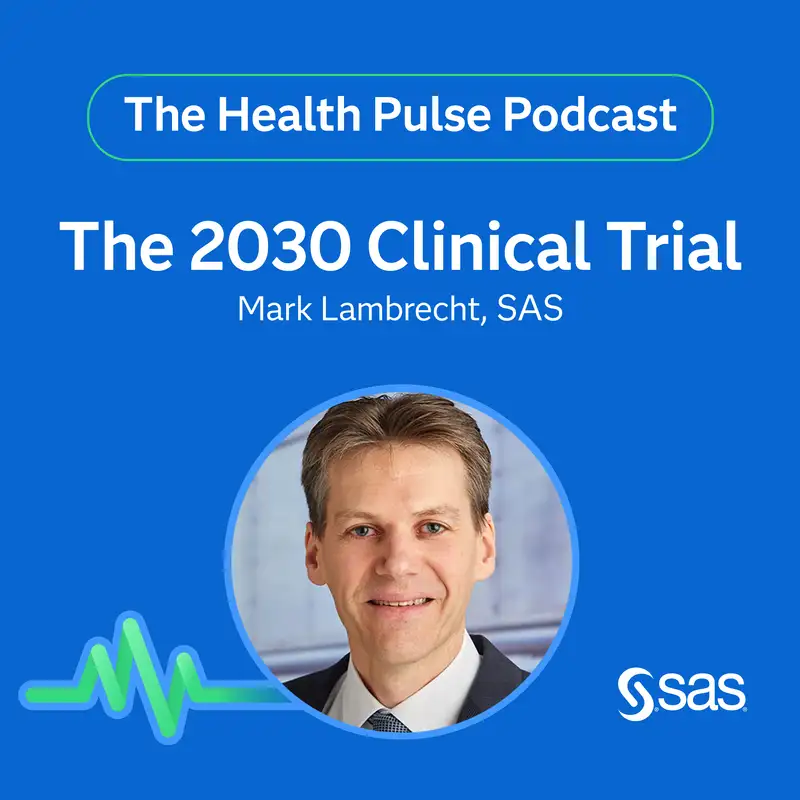
ALEX MAIERSPERGER: What problems will AI solve for human health? Mark Lambrecht from SAS joins us to share his perspectives on the pressures facing today's clinical trial designs and the innovative approaches that will redefine them.
When you look forward to 2030, which wildly is not so far away, what forces are placing the greatest pressure on today's clinical research model?
MARK LAMBRECHT: There's a couple of them, Alex. I think one of the pressures that we see is the amount of data that is simply coming to those clinical trials. The pressures of data are compounding. And we need to make value from those data. According to joint research by the Tufts Center and TransCelerate, a typical phase III clinical trial today gathers nearly 6 million data points per protocol. And that's a massive 280% increase over the past decade alone so growing at 11% annually.
At the same time, only 25% to 30% of this total collection burden is not used. It's completely non-core or nonessential. And so we're burdening the patient with a lot of data collection. We're burdening the clinical sites with a lot of data collection and then simply not using it. So what we need to look at is that non-essential administrative function and do away with that and be more intelligent in terms of the data that we do gather in a clinical trial.
Of course, there are other forces like the force to innovate constantly. We see the acceleration in innovation. And there's, of course, of course, the cost of the whole clinical trial enterprise and the cost to bring a new medicine to market, which is enormous as well. But that has been well published, I think. We're here at a junction, really. We have an opportunity to do better for the patient.
ALEX MAIERSPERGER: Cost, administrative complexity, amount of data-- sounds like just a lot of forces, and to your point, all at the same time. So fast forward, we're now sitting here in 2030. Maybe we've got some different clothes on. I don't know what they're going to wear in 2030, maybe brighter colors, whatever it's going to be. What looks completely different about how clinical studies are designed, analyzed, and submitted?
MARK LAMBRECHT: Right, I see a couple of things here. The first thing is agentic AI. There's no denying it's here. And that will only evolve, get better. They will make less mistakes. They will get more intelligent. We can already see agents and working together to hack another system. And there are accidents happening, even.
But in clinical trials, you will have those agents really helping medical monitors, helping clinical scientists make sense of the tasks they do. And they will be everywhere. There will be popping everywhere. You will see them assisting in protocol generation, automation of patient recruitment, drafting, helping to draft regulatory submissions, but always with humans reviewing and in the middle of what needs to happen, authorizing every recommendation. As you say, 2030 is not that far away. So it's really not going to change there.
The second thing that I would like to highlight is statistical methods. You already see the FDA publishing the ability to use Bayesian trials to use so-called real-time clinical trial techniques. So what that will do is it will overhaul the clinical trial from being a very batch-driven process, where one group transfers their work to another group, clinical data managers to statisticians, statisticians to doctors, doctors to regulators, to become more of a continuous enterprise whereby they're working together on that and where there's more oversight during collection of the clinical trial, hopefully with less effort.
Again, to our previous point of the clinical sites not having to enter 15 times the same data because, accidentally, they run 15 clinical trials with 15 different pharma sponsors. But they can actually use one system that is used then by those companies. So that is all very important.
The real-time clinical trial has been heavily advertised by the FDA and by regulators, and you see a lot of collaboration there. There were some pilot trials with AstraZeneca and with Amgen. And it is possible. It's not about changing the trial as such. It remains a randomized clinical trial. But it's about changing the way that the data is submitted to oversight, to independent data monitoring committees, to safety committees, and also, finally, to the FDA as they review the actual device or the new medicine that comes to market.
So I see that whole ecosystem changing. I briefly mentioned Bayesian trials, just a word on that. That means that we can look at previous trials, historical trials, to inform us of how new trials need to be informed. And you can already see in oncology these new therapies coming along that are more open trials and that use more different and innovative protocol designs as well.
And that has an impact for statisticians, but it also has an impact on how we collect data. Maybe we'll need less patients. Maybe we'll need-- we can reuse more data. And so again, we decrease the burden on the patient, only a good thing.
ALEX MAIERSPERGER: I tried to fast forward us to 2030, but it sounds like in 2030, it wouldn't be me and you talking. It's going to be my AI agent talking to your AI agent. They're going to be that prolific.
MARK LAMBRECHT: Well, to some extent, although I want to put an important comment to that. And I'll give you an example. Take a medical monitor. A medical monitor starting their work overlooks the clinical trial and looks at what data is coming in. Is it coming in in time? Is it complete? Have all the data been entered, et cetera?
Maybe by 2030, that agent will have worked overnight while the medical monitor is sleeping to look at the data coming in, look at device data. Maybe decentralized trials will gather more data of patients at home. It will have flagged, I don't know, 11 inconsistencies, drafted the queries, and attach that to the source record.
So by the morning, when the monitor sits down, he or she is not hunting for problems. They're really adjudicating a prioritized list of such. Maybe only 2 of those 11 issues that were flagged by the chat bot or by the agent will have been clinically interesting. And they can then be escalated.
So helping to prioritize the work that is already happening, effectively speeding up the trial in every particular way. And as we know from compound interest, a lot of benefits in each of different actions will compound to a big benefit overall, and hopefully, a shortened clinical development timeline.
ALEX MAIERSPERGER: Really exciting to hear the opportunities that lie ahead of us and that are here now. You said two things that are somewhat opposed. You talked about the batch processing and just the way of doing business now, and then, the need for innovation. And so if we do have that right now, you said, explosion of data, you obviously have to analyze that data. You've got to report on it. You've got to submit it.
Those processes remain fragmented now. Can be in that batch process as one team in one part of the globe does this one function. Another team on another part of the globe does this other function. And they might not work together as seamlessly as we'd like or as the organizations would like now. So how do organizations go from where we are now to operationalizing innovation?
MARK LAMBRECHT: Yeah, I think a couple of things there. I see a lot of pilots being set up to test out these approaches. And I think some of those pilots are really about technology thrown at the problem to see how it solves. The people in the field know the context the best. It is the monitors. It is the clinical trial site coordinators, the statisticians, the data managers that understand how they're working together.
And those pilots need to be embedded in the outcomes that they want to generate. If that happens, you'll see truly a transformation of the field and working together. And I think you'll see by the embedding of those new agents as such, the new technologies, the new way of digitizing, for example, a clinical trial protocol, naturally, those groups will be drawn to each other and will start asking questions to each other in a more organic way, finding out that the previous borders they had will need to be broken.
I'll give you one concrete example. Clinical trial protocols are currently being looked at as becoming a machine readable protocol. Today, a lot of those trial protocols are still manually drafted by people, by scientists or by clinicians. Why not transfer that information in a machine readable protocol, so that we can start mapping them against standards that the programming code can be pre-generated by some agent and then be validated by experts to look at, is it really what we need?
In other words, that sequential chain that used to happen is really being compressed a little bit to make sure that these groups work together. And as such, you'll have more collaboration. That's just one example of where I will see more collaboration happening.
Of course, humans will be essential. Picking up the phone, sending emails will not go away, but it's more that overlay of technology that will speed up things and speed up collaboration. In order to get there, Alex, we'll need change management. That will not come for free. People will need to be trained to understand that. We will need to listen to people that have done this for years. Their jobs will not go away, but their jobs will be profoundly changed by the impact of that technology.
But hopefully, they will find that they move, for example, from a person that is looking at a very narrow part of the process to be being more in charge of a clinical trial, a therapeutic area, and as such, getting closer to the patient data and what the clinician really needs to see, what the regulator needs to see.
ALEX MAIERSPERGER: What capabilities will organizations need if they want to support this vision that you've laid out for clinical innovation 2030? You've talked a little bit about the people side, the change management side, the technology side. Get into a little bit of the specifics of what they're going to need now.
MARK LAMBRECHT: Yeah, I think a couple of things here. First of all, I did mention the agents, didn't I? And I think that that will be important in that operating model. But the agents will really need to be working in a non-autonomous way. In other words, how will we interlace them with human activity? And in order to do that, we need to map them against the risk we're taking to put an agent on a certain task.
So the first thing will be to go from assistance to agentic workflows that are in context. I'll give you an example. There is no regular pathway that will just approve what an agent has been producing. It's really about accountability. It's really when the FDA knocks on the door of the pharma company, it is a person that will have to respond and need to understand what has happened in that trial.
But in order to embed that need to go in a step-wise process where you ask yourself, OK, what questions need to be assisted with? Where is the chain, the workflow? Where can we delegate certain tasks? How can we supervise those tasks? And what parts of the process can we make autonomous or should we avoid at all times to make autonomous? For example, we don't want agents to think about the outcomes of a clinical trial or changing the protocol, as such. Those need to be human clinical decisions.
The second thing is we will need to keep investing in metadata-driven automation. In other words, the standards are important. We know standards from data standards, but we will need to have standards also in how agents are working together. And those are now becoming available. SAS, as such, is investing heavily, for example, in MCP as a protocol so that you can have multi-agentic frameworks where the interfaces that humans are looking at are working together with those agents, and the tasks are being automated.
The second thing is GXP and being qualified, being validated, ensuring that everything happens according to a repeatable pattern. And you need to have defined data flows. You need to have the ability to have sandboxes to test out different approaches as such as well. Interfaces will need to be redesigned.
And you need to have a platform approach as well, a platform approach where you don't want to create all technology in you, in your own organization, but where you can reuse innovation that is happening, where your future proof of what will be happening. We don't know what will be coming next year, so we need to be open and interoperable enough to ensure that whatever that clinical trial information is landing on is suited for analysis, is suited for overview by both technical and non-technical people at the same time.
So it's really a redesign, an essential redesign of the whole clinical trial paradigm that will happen not overnight, but over the coming years, and that many of our pharma users are currently looking at and investing in.
ALEX MAIERSPERGER: The vision that you've laid out for the overall redesign of the clinical trial process is, I think, something that many organizations are going to agree with and say, yes, we've got to get there. We need to have the summaries overnight ready for the people in the morning. We need to have global teams working more closely together. We need to be able to have these capabilities for our people to work at their best.
The challenge, I think, is the practical change today. I can already foresee a little bit of the overwhelm of this vision looks beautiful, but this is agents that we've got to coordinate. We have to deal with regulations that are different in different parts of the world. Our teams maybe don't have either the technology right now or that change management. They're not ready for this.
And so practical change today, do you start with the platform? Do you start with-- I think someone's going to hear this and say, I need to go out and get AI agents, and they've got to be doing things. Do I run out? Do I buy them? Do I build them? Where do we go? So give a little bit of practical change that they can go do tomorrow.
MARK LAMBRECHT: Well, a practical change is to look at where you spend the most time on. Many pharma customers have KPIs to reduce the time from what they call database lock to submission, or from data first patient in to collecting that data in an analytical format-- so different KPIs across the whole value chain.
And it's a question of measuring where you have big time effort, where you're spending a lot of time, where you're spending a lot of resources, and where perhaps things are not going as smoothly as you would like to. Let's not forget that many pharma organizations also have legacy environments. They need to keep the existing clinical trials running. They need to keep responding to regulators that have questions of trials that they started maybe 5, 6, 7 years ago.
And so you can't change everything overnight in the way you work. But it is a question of analyzing those KPIs and thinking about which processes are subject to automation. For example, at SAS, we are investing in clinical data mapping using agentic AI quite a bit. And we will issue that very soon as well to our users in a way that we know that if an organization is mature enough in the use of standards, in this case CDISC standards, that we can plug in those very narrow-based agents that will help them map data into a certain format that can be useful to them. So these are steps you can take today. And you monitor, of course, the impact of what that does.
The second thing is you need to be wondering, and probably, that's a little bit more in the IT side of the house. Do we have the right platform available? Do we have the right technology in house? That's not just a technology from SAS, but throughout the whole clinical ecosystem. Are we investing in innovation to bring electronic health record information straight into our clinical research paradigm? Do we have the ability to digitize our clinical trial protocols? And what will that impact our clinical flow?
So it's a matter of really looking at that and then starting to set up a couple of new trials, really, with that technology as you have chosen your path forward. It's not enough to just plug in a system and plug in a new system and think, OK, now I have agentic AI. I'll lean back, and I'll see what happens. It's a question of constantly measuring the engineering, the good old engineering approach where you make a change, you measure something, and you see if it improves things.
Keeping in mind the risk of applying some of those agents at the same time-- some of these processes will be worse than what humans can do. And humans should not be replaced. In other areas, we know that humans are not very good to look at data in an Excel file, and they will make mistakes. So that's where agents typically outperform humans.
So it also depends on the therapeutic area, looking at patient data, how you collect it. Techniques like synthetic data are part of-- it's not just the gen AI and the agents. It's also about new analytical approaches that will allow us to reduce the burden on the patients. And every month, we can shave off of a clinical trial is a month that the patient will have access to the innovative therapy faster. And yeah, that's why we're here, right?
ALEX MAIERSPERGER: I love the problem specific starting point of pick where it's taking the most time. If you can shave off that time, you can move on to the next thing that's taking the most time and next. And so love the approach you took. One prediction you made has me worried where you said that we're still going to be emailing in 2030. For sure, I think we need to hear a prediction maybe by 2035, we won't need email anymore.
MARK LAMBRECHT: I will try. For you, Alex, I will try.
ALEX MAIERSPERGER: Thank you. So one prediction was worrisome. The other visions that you've laid out are incredibly exciting, and to your point, get patients drugs that they need faster. What's one prediction that you have about clinical research in 2030 that people are going to find difficult to believe today, but you think will ultimately become reality?
MARK LAMBRECHT: Yeah, I really hope that AI will be used at the patient site, at the patient-provider interface for clinical trial research. I'll explain myself. Today, there's basically two ways in which you can apply AI. We've spoken a lot about the operations of the whole clinical research paradigm, a little bit invisible to patients out there but very important to get those therapies to market faster. We know that that will happen. I'm not worried about people experimenting. A little bit worried about enterprises thinking in sea levels that everything will change overnight. But OK, that will take some time, and we will get there.
But I read a scientific paper last week that mentioned that the impact of AI in drug discovery is really not impacting that much the new therapies getting to market. And the reason is that, in the past, technology has been thrown at problems, but that really did not measure the clinical impact for patients.
For example, we all know DeepFold and AlphaFold from Google. Yes, it helps us to look at proteins in a 3D structure and predict them. But it's not because you have a ligand that you have a clinical therapy for a patient. And that's the gap we need to close. We need to bring that AI to the clinic. We need to bring the AI to the clinical trial and to help measure the impact and really be a proxy to the impact that the therapy finally will have on the patient so the patient doesn't need to wait for years until we can finally see the impact on the disease.
And we're getting there if you look at some of what is happening with the retina scans of eyes, for example, where we can predict if certain patients will be prone to certain chronic diseases where we can have all sorts of multimodal data helping to analyze patients in a responsible way.
But in order to make it impactful in the clinical trial, we'll need to measure that AI as if it were a medicine itself. In other words, we need to research it. And the FDA has recently issued a seven-level maturity model of how to bring AI into clinical trials and when they will accept it as a tool, really, to impact the patient itself.
And so that's really what I hope that, as technologists, we can bring this technology not just for the operations, and let's say, design more candidates, but really, design therapies that will help the patient live longer, live healthier, increase the quality of life in the case we cannot resolve the disease, like diabetes, but at least increase the quality of life and reduce the burden of diseases such as many other diseases we can give as an example.
ALEX MAIERSPERGER: The pressures on the clinical research model of today are pushing organizations to invest in improved human capabilities, improved technology capabilities, and are only going to make the clinical research model in 2030 be the best that it can be. And I, for one, can't wait for that. I think the vision that you've painted and the focus on the patient at the end of it is going to be, we're all going to see the benefit from it. And so thank you, Mark, for being on the Health Pulse Podcast.
[THEME MUSIC]
MARK LAMBRECHT: Thank you so much, Alex. It was my pleasure.
ALEX MAIERSPERGER: Thank you for joining. If you'd similarly like to end email by 2030 or you'd like to share your thoughts on clinical trials, please email us thehealthpulsepodcast@sas.com. See you next time.
Creators and Guests